
Hearst, Ontario (Archean-aged Kabinakagami Lake greenstone belt)
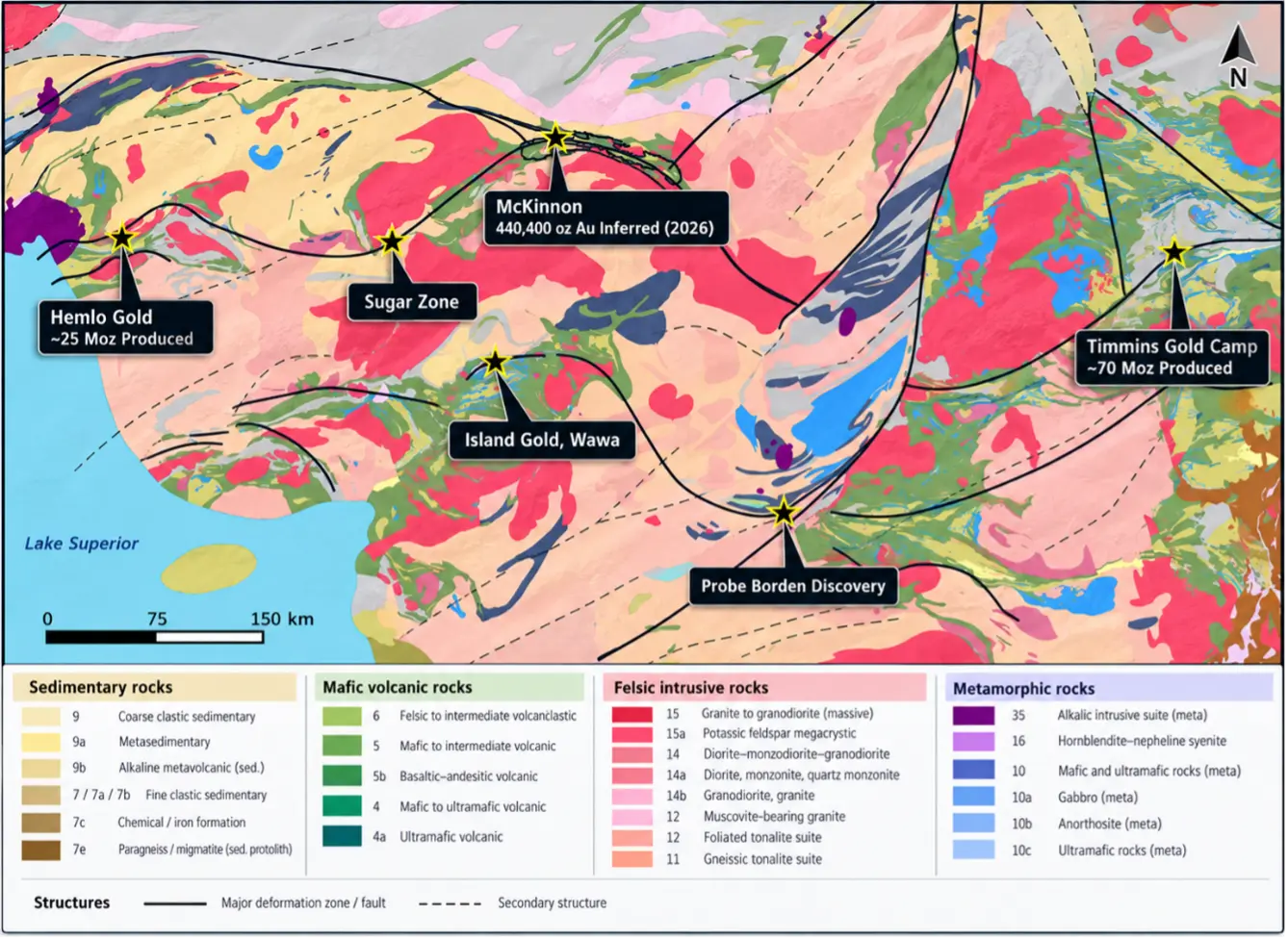
McKinnon Deposit, Hawkins Gold Project Inferred Mineral Resource Estimate – Effective Date of September 11, 2026
Mineral Resource Type | Cut-off | Tonnes | Au Grade | Contained Au (koz) |
Pit-Constrained | 0.24 | 12,645 | 0.89 | 360.0 |
Out-of-Pit (Underground) | 1.2 | 1,371 | 1.82 | 80.4 |
Total Inferred Mineral Resource | 14,016 | 0.98 | 440.4 | |
Notes:
Mineral Resources that are not Mineral Reserves do not have demonstrated economic viability.
The Mineral Resource Estimate was prepared in accordance with the CIM Definition Standards on Mineral Resources and Mineral Reserves (May 2014) and the CIM Estimation of Mineral Resources and Mineral Reserves Best Practice Guidelines (November 2019), as required by NI 43-101.
The entire Mineral Resource is classified as Inferred. An Inferred Mineral Resource carries a lower level of confidence than an Indicated Mineral Resource, is based on limited geological evidence and sampling sufficient only to imply but not verify grade and grade continuity and must not be converted to a Mineral Reserve. Confidence in the estimate of Inferred Mineral Resources is insufficient to allow the meaningful application of technical and economic parameters, or to enable an evaluation of economic viability worthy of public disclosure. There is no certainty that any part of the Inferred Mineral Resource will be upgraded to a higher confidence category with further exploration. It is reasonably expected the majority of Inferred Resources could be upgraded to higher resource categories with continued exploration and drilling.
Metal price and process assumptions: US$3,500/oz Au, 0.72 CDN$/US$ FX, process recovery of 93% Au, process cost of CDN$27/t, and G&A of CDN$8/t.
The assumed gold process recovery is supported by whole-cyanidation metallurgical test work commissioned by Falconbridge Limited at Lakefield Research in 1985 on seven samples of Project mineralization, which returned gold recoveries ranging from 82.3% to 98.0% and averaging 92.2%. No modern metallurgical test work has been completed on Project material.
MRE constraining parameters: pit optimization used mining costs of CDN$3.50/t mineralized material, CDN$3.25/t waste and CDN$2.75/t overburden with 50-degree pit slopes at a 0.24 g/t Au cut-off. Out-of-pit blocks were reported above a 1.2 g/t Au cut-off at a mining cost of CDN$140/t, below the constraining pit shell and within the constraining mineralized wireframes, and exhibit continuity and reasonable prospects for eventual economic extraction using long-hole underground mining methods.
A bulk density of 2.70 t/m³ was applied to all waste and mineralized blocks. Overburden was assigned a bulk density of 1.8 t/m³.
Tonnes, grades and contained ounces are rounded to reflect estimation precision; totals may not sum exactly and contained ounces may not reconcile exactly against rounded tonnes and grades. Contained gold ounces are in situ and make no allowance for processing losses.
The QPs are not aware of any known environmental, permitting, legal, title, taxation, socio-economic, marketing, political or other relevant factors that could materially affect the MRE.
The 2026 surface exploration program confirmed high-grade gold mineralization at multiple prospects beyond the McKinnon Deposit, reinforcing the potential for additional mineralized zones across the broader Hawkins property.
These results provide additional targets for follow-up exploration outside the existing McKinnon resource area.
True widths of channel samples are currently unknown. Selective grab samples are not necessarily representative of average mineralization grade or continuity.
Geology, Geophysics & Targeting
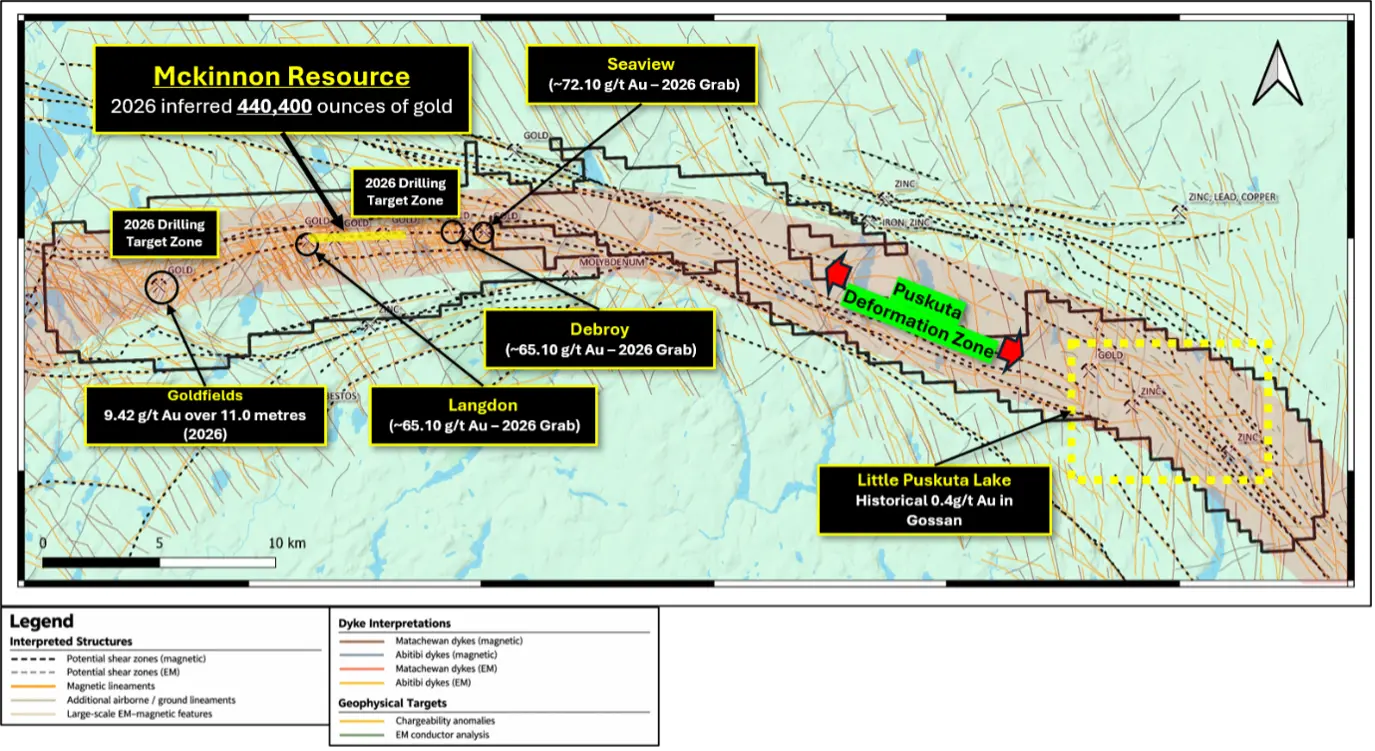
Epic Gold’s exploration strategy is focused on evaluating opportunities to expand the existing McKinnon resource while systematically advancing new gold targets across the broader property.
Priority Activities include:
Qualified Person
The scientific and technical information has been reviewed and approved by Mark Richardson, P.Geo. (OGQ Permit No. 10929), a Qualified Person as defined by National Instrument 43-101.